Species
Black Crappie
On record in 241 waters across 11 states
Black crappie travel in schools and suspend around cover, which means when you find one, you've usually found a bunch. They're one of the better-eating panfish in freshwater, which is part of why crappie season gets circled on calendars across the Midwest and South.
Black Crappie are on record in 241 waters across 11 states, most heavily in Washington, Wisconsin, Indiana, Utah and Florida. FishableWaters tracks every black crappie stocking from state agency reports — use the state links and most-stocked list below to find waters near you.
By state
Most-stocked waters
- Tims Ford LakeTN19×
- Cherokee LakeTN16×
- Norris LakeTN16×
- Watts Bar LakeTN14×
- South Holston LakeTN13×
- Douglas LakeTN12×
- Center Hill LakeTN11×
- Normandy LakeTN11×
- Baldwin LakeIL5×
- J C Murphey LakeIN5×
- Lake StoneFL5×
- Watauga LakeTN5×
- West Boggs LakeIN5×
- Lake ClintonIL4×
- Lake BryantFL4×
How to catch them
Crappie suspend near brush piles, standing timber, and dock pilings, holding at a specific depth rather than sitting on bottom. Vertical jigging with electronics to locate suspended schools, or slow-trolling multiple jigs at once, are the two dominant approaches on open water.
Small jigs in the 1/16 to 1/32 ounce range, tipped with or without a minnow, are the standard crappie bait. Live minnows fished under a slip bobber near brush or timber also produce consistently.
Know your fish
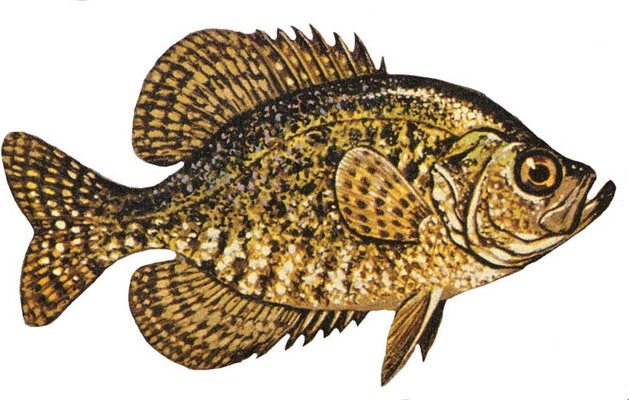
Silvery body with irregular black speckling scattered across the flanks, rather than the vertical bars of a white crappie, and a deep, laterally compressed body shape. The dorsal fin has seven or eight spines, one more than white crappie typically carry, a detail that matters if you're trying to tell the two species apart.
Spring, when crappie move shallow to spawn around brush and stumps, is the most popular and most productive time to target them. Fall brings another strong bite as schools chase baitfish before winter, and winter fishing over deep brush piles can be excellent where crappie remain accessible under ice or in open water.
Freshest black crappie stockings
| Jul 2, 2026 | Hackberry LakeNE | 9,607 |
| Jul 2, 2026 | Watts LakeNE | 20,935 |
| Jul 2, 2026 | Hackberry LakeNE | 52,539 |
| Jul 2, 2026 | Willow LakeNE | 50,043 |
| Jul 2, 2026 | Watts LakeNE | 4,541 |
| Jun 23, 2026 | Davy Crockett LakeTN | 10,472 |
| May 12, 2026 | Crystal BayMN | 100 |
| Apr 26, 2026 | Elm LakeND | 12 |
| Apr 16, 2026 | Powderhorn LakeMN | 47 |
| Apr 16, 2026 | Wirth LakeMN | 14 |
| Apr 15, 2026 | Snelling LakeMN | 33 |
| Apr 14, 2026 | Berg SloughND | 12 |
| Nov 25, 2025 | Dewey LakeMI | 1,500 |
| Nov 19, 2025 | Normandy LakeTN | 22,356 |
| Nov 19, 2025 | Tims Ford LakeTN | 47,803 |
Black Crappie — FAQ
Where can I catch black crappie?+
Black Crappie are stocked across 11 states, led by Washington, Wisconsin, Indiana, Utah and Florida. Pick a state below to see every water stocked with black crappie.
What's the best bait for black crappie?+
Small jigs in the 1/16 to 1/32 ounce range, tipped with or without a minnow, are the standard crappie bait. Live minnows fished under a slip bobber near brush or timber also produce consistently.
When is the best time to catch black crappie?+
Spring, when crappie move shallow to spawn around brush and stumps, is the most popular and most productive time to target them. Fall brings another strong bite as schools chase baitfish before winter, and winter fishing over deep brush piles can be excellent where crappie remain accessible under ice or in open water.
How many waters are stocked with black crappie?+
241 waters across 11 states hold black crappie on record, updated daily from agency stocking reports.